Showing posts with label Rosary Meditation Series. Show all posts

Wednesday, June 11, 2014

The Visitation

The Second Joyful Mystery: The Visitation
The Fruit of the Mystery: Ministry by allowing Elizabeth her joy


A year ago I wrote a post on the Magnificat. One of the parting points of the piece, and the "thesis" of the post, was the following:
Elizabeth's greeting is Mary centric. It is all about her greeting, her voice, her womb, and her response to God. Mary does not condemn this, but she redirects it. She changes all of the you to He. It is not about what she has done for God, it is about what God has done for her, and for everyone else.
"...the Almighty has done great things for me, and holy is his Name."
[...] while proclamation is more active, magnification is a passive thing. When a magnifying glass is placed in front of something else, it cannot help but to magnify it.
In my last post, on the Annunciation, I focused on what exactly the Almighty did for Mary: namely, leveling the playing field for her from the start so she had the freedom to choose Him. This is a leveling He does vocationally for each of us; although (because less is asked) less is given to us than to Mary.

Mary, the perfected recreation of who we were meant to be, blazed a trail for us to follow when she walked her path. If we are to take the Joyful Mysteries as an encapsulation for us of what our own vocational journey should look like, after this moment of super-abundant grace comes the next scene, the Visitation, where others recognize something extraordinary in us. When your life has just been changed and re-shaped by an unmerited gift, personal praise of this nature can be hard to stomach.

But Mary doesn't just redirect the praise. She allows Elizabeth her joy. This, more than any physical acts of service she did while she was there, was her primary act of service to her cousin.

Mary was not given her vocation for herself, but for the world. After the acceptance of the gift, she goes out. Out to the hill country of Judea, out on a long and arduous journey, out to minister. Our vocation, if it is from God, should not merely deepen our interior life; it broadens our heart outwards to include others, to allow us to embrace the world.

Sometimes when we embrace the world it responds coldly; it does not understand. Other times when we embrace the world it understands completely. It rejoices because we have given it hope. Elizabeth said to Mary:
Blessed is she who believed that there would be a fulfillment of what was spoken to her by the Lord.
Elizabeth was in a unique position to understand Mary since she herself was the beneficiary of a miraculous act.  Yet Mary also came to help Elizabeth better understand her own vocation. Mary's arrival happens in a critical period in Elizabeth's life: after she was the recipient of a miracle but before her husband's lips were unsealed to explain to her the larger significance. Up until the Visitation, Elizabeth saw the gift of her unexpected pregnancy as something given to her by the Lord "to take away my reproach among men." (Luke 1:25) Given that she saw John the Baptist as a personal gift to herself, it would not be surprising for Elizabeth to initially see Mary's pregnancy in the same way. After all, in those times, fertility was tightly linked in social and religious perception to divine favor. Yet she said "Blessed are you among women" as a direct out-flow of the inspiration of the Holy Spirit. She saw Mary and her cooperation with the Divine Will as good in and of themselves because, by the very act of her yes, even before accomplishing anything wonderful in the world, Mary opened Elizabeth's eyes to the realm of what was possible with God's grace.

The best way that Mary can help Elizabeth correct her perception of her pregnancy and understand that her vocation is a gift not to herself but to the world is to let Elizabeth be the first beneficiary of the manifold gifts that Mary's own vocation will give to the world -- to be the first of the children of Israel to feel hope at the coming of Christ  ("Why is this granted me..."). Hope that He would make all things new and accomplish something beautiful in us.

That is the kind of witness to beauty that we with our vocations are called to give. This witness does not allow us to hide in humility, but sometimes it is far more humble to simply shine.

Wednesday, April 23, 2014

The Annunciation

The First Joyful Mystery: The Annunciation
Fruit of the Mystery: "Yes" to the unknown

Fra Angelico, The Annunciation, San Marco Monastery, Florence
I've already explained here why Fra Angelico is my favorite artist, so I won't dwell on that; I'll merely say that this is my favorite depiction of the Annunciation. The specifics of its theology will probably come up over the course of the post; for now it speaks for itself.

As stated here this series of meditations on the rosary is set in the context of a vocational journey. And so let us begin.

God comes into our lives and announces to us that great plan that he has for us. At times he does this directly, and at times through intermediaries -- just as the angel Gabriel was an intermediary to Mary. At times the vocational call is something we have known for all of our lives; at times it is a total surprise -- something we have never imagined. The Virgin Mary's call certainly falls in the latter category. Though  the length of time between when one hears the call and when it comes to fruition can vary greatly, one thing is constant: it is always something for which God has been preparing us for all of our lives -- just as he prepared the Virgin Mary by her Immaculate Conception.

It is crucial to make a distinction here. Although God has been preparing us for this moment for all of our lives, this is not Calvinistic predestination. We still have the freedom to reject it -- although this would be a rejection and a fracture of our own being (this idea is expressed very well in And You Are Christ's by Fr. Thomas Dubay). Mary, just like us, would have been capable of rejecting the invitation to be Christ's mother had she wanted to do so; in the Immaculate Conception God merely gave her the enormous grace necessary to be able to understand and accept His call.

There are several reasons why this is so interesting to me. The first is that something about the combination of the Immaculate Conception and Annunciation has always (ironically) struck me as a bit too Calvinistic to sit right -- especially when you have hymn verses like "predestined for Christ by eternal decree."1 Mary, however, is not predestined in the traditional Calvinistic fate-robot sense of the word. To see why, we have to look at the nature of concupiscence.

Concupiscence, as it turns out, is a tragically misunderstood word. Most dictionaries, in a form of demented synecdoche, equate a facet of it -- sexual desire -- with the whole thing; however concupiscence is much more than simply a synonym for libido. According to CCC 405:
[O]riginal sin [...] is a deprivation of original holiness and justice, but human nature has not been totally corrupted: it is wounded in the natural powers proper to it, subject to ignorance, suffering and the dominion of death, and inclined to sin - an inclination to evil that is called "concupiscence". Baptism, by imparting the life of Christ's grace, erases original sin and turns a man back towards God, but the consequences for nature, weakened and inclined to evil, persist in man and summon him to spiritual battle.
Our own concupiscence makes it hard for us to follow God's will in our lives. An absence of concupiscence doesn't mean we are obligated to do good, merely that the playing field is level instead of tilted. With concupiscence, the devil already has a foothold in our hearts before the battle even starts. We're already inclined to listen to him. For Mary to have been born with concupiscence would have been the ultimate lottery for him. If you have to fight a battle just to not snooze the alarm in the morning, just think of the war he must have waged against the woman "destined" to crush his head with her heel. No concupiscence doesn't mean no temptation -- just look at Eve -- it just means the slate is clean; there's no "acquired taste" for sin.

God gives us this grace as well -- although it is not necessary for him to totally remove our concupiscence.  Without this grace we would be utterly incapable of accepting the magnificent gift he offers us; it would seem to us like a punishment instead of a gift. It is critically important that we see Mary's fiat in this same light -- if she becomes roped into Divine Motherhood by her pre-conception acceptance of unsolicited gifts and the accompanying obligations, one of the most profoundly beautiful aspects of salvation history goes stale. Just like with the dual-authorship of the Bible, God has the divine condescension, the profound humility to let humans share the credit for the mystery of his grace working in our world.

This is why Mary is the New Eve, and why her "Yes" is so beautiful. She, like us, had the power to say "No." She, like us, was given the grace to have the freedom to say "Yes."

There are many times in our vocational journey when we are asked to say "Yes." Most of them are mundane and have no angels or moments of Divine Revelation, they are nothing more than painful perseverance on a path we have already begun to trod. But here, in the Annunciation, we meditate on the grace Mary received to make that first painful, beautiful fiat. There would be other, more meaningful surrenders later (with Simeon at the presentation, in the crowd as the mob yelled "Crucify him!", at the foot of the Cross), where she knew just how much was asked, and still surrendered all.

The Annunciation is a jump into an abyss. It is a "Yes" to an unknown: an act of love, an act of trust, an act of grace.
________
Thankfully for my spiritual life I generally tend more towards the "I'm too stupid to understand what's actually going on" than the "let's nail my objections to the Church door" approach; as an end result I developed a voracious appetite for reading apologetics materials in high-school.


Thursday, June 27, 2013

Rosary Meditation Series: The Mysteries of the Rosary as a Vocational Journey

I am currently abroad in an undisclosed foreign country, and I have a 40 minute walking commute to work every morning. Since I work at a Catholic University and they have mass in the morning in the chapel, the streets are still peaceful and empty at the early hour at which I traverse them. As I became familiar with the route, my steps gained a certain automaticity, enabling effective multi-tasking. Never one to see time go to waste (except on the Internet), I decided to pray the rosary during my commute, and it became a habit that stuck.

With the occasional exception here and there, my family has prayed the rosary together every night for as long as I can remember. This, in my perspective, has always been simultaneously good and bad. There are obviously abundant graces that come from praying together as a family, and I know that it taught me early on that prayer and the faith were both things that were to be valued and prioritized. Even when our days were busy, we still found time for the rosary. Familiarity with the prayers and traditions of the church is beautiful; however, my familiarity reached the point of automaticity. I gained the super-power of being able to reach the end of the decade of a rosary, having orally prayed all of it yet without the faintest recollection of having done so. The trap of automaticity is always there waiting for me when I pray the rosary; because of this it has long been hard for me to pray it devotionally. It has rarely been my prayer of choice -- unless on car trips or to kill time; however as I have matured into other aspects of my faith, my interest in the rosary has been slowly awakening. The art of Fra Angelico brought me to an appreciation of the Annunciation, and that then became a portal to dive deeper into the rest of the mysteries. I began to realize that the mysteries were not just arbitrary events in Christ's life; I realized they reflect our own lives, struggles, and journeys, and show us how to live our faith. Dominic preached the rosary and won the hearts of the Cathars. By understanding the mysteries of the rosary, we understand the mysteries of our faith. My morning commute has been the final straw in making me fall in love.

I want to frame this series in the context of the nature of the rosary as a hylomorphic prayer -- a prayer that possesses both body and soul and loses its nature if separated from either. Just as the automaticity of my steps allowed me to meditate on other things while they still led me to the University, automaticity of praying the rosary can open a door to deeper meditation -- though all the while our steps through the rosary still form a foundational undercurrent directing our thoughts toward the divine.


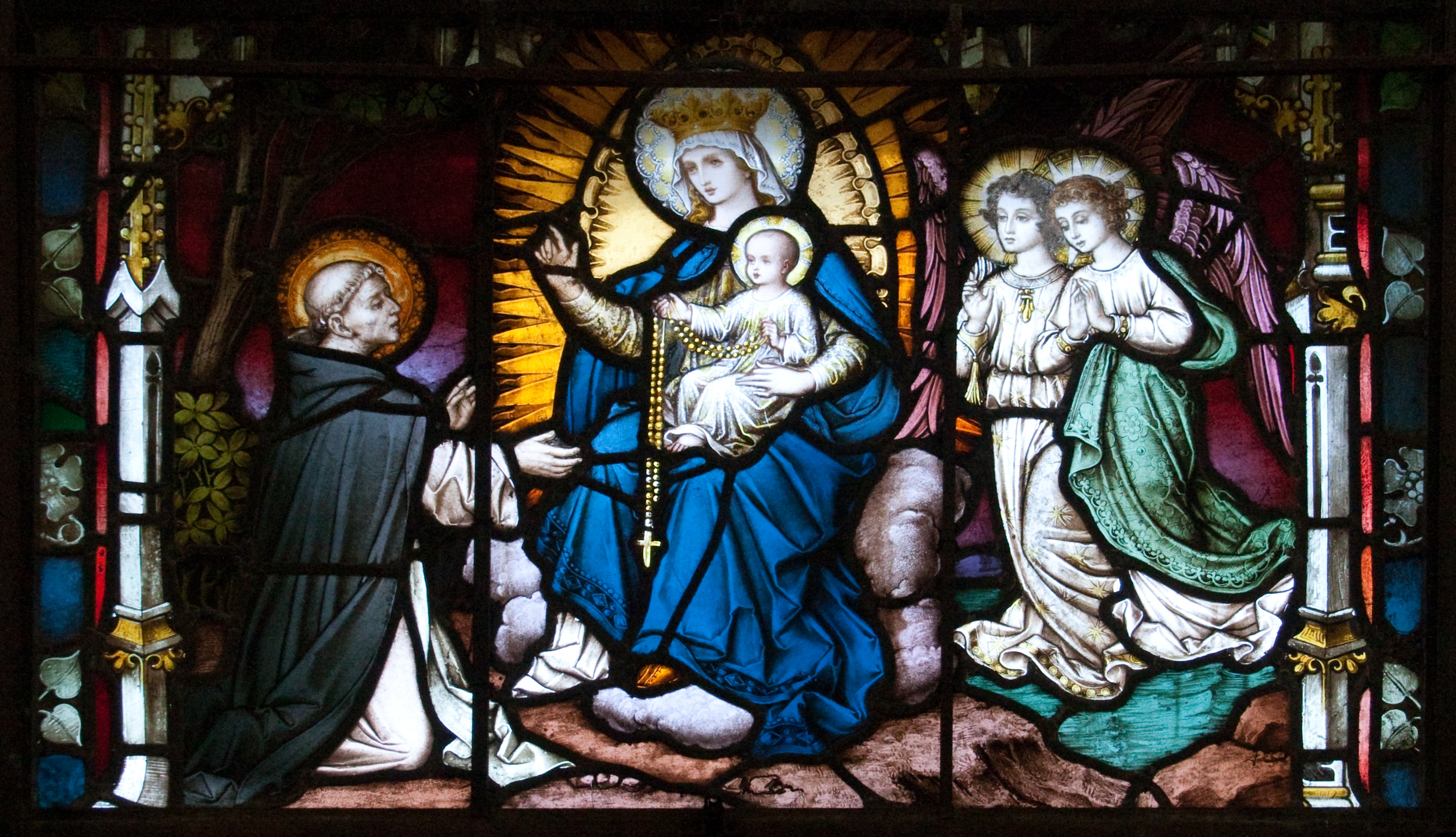
Our Lady giving the rosary to St. Dominic

I will hyperlink entries as they go up. They might not go up in order, since I'm still fleshing out the parallels on some of them.

The Joyful Mysteries
The Visitation
The Nativity
The Presentation in the Temple
The Finding of the Child Jesus in the Temple

The Luminous Mysteries
The Baptism in the Jordan
The Wedding Feast at Cana
The Proclamation of the Kingdom
The Transfiguration
The Institution of the Eucharist

The Glorious Mysteries
The Resurrection
The Ascension
Pentecost
The Assumption
The Coronation

The Sorrowful Mysteries
The Agony in the Garden
The Scourging at the Pillar
The Crowning with Thorns
The Carrying of the Cross
The Crucifixion