Thursday, June 27, 2013

Fra Angelico

As I was getting ready to begin my post on the Annunciation, I realized that it was about to become a post on Fra Angelico. Since that would do justice to neither the Annunciation nor Fra Angelico, the friar gets his own post.

 
Dominic et al at the Coronation

Fra Angelico's real name was Blessed John of Fiesole, which I just learned from Wikipedia. So if you want a good historical explanation about him, you should consult that and not me.

What really interests me about Fra Angelico is San Marco Monastery.

Cell 3 in San Marco
Fra Angelico (and his helpers) painted devotional images in the cells of the friars in San Marco. These are significant for a number of reasons.

They're simultaneously a set and a series. There's a progression in their subject matter depending on the stage of religious life the occupant was in (the novices traditionally occupied a certain block of cells). The novice cells were primarily filled with crucifixions, since that had to be understood before anything else. St. Dominic also gets older as the images progress into the cells occupied by older members of the congregation.

While all of that is interesting, my fascination comes from the following:

1. They were painted for the friars, not for the world.
Fra Angelico did not expect to gain fame during his lifetime for painting them. They were painted in cells: a part of the monastery closed to the public. Like Michelangelo sculpting the back of David even though he thought no one would see it, Fra Angelico painted for God.
Noli me tangere


2. He is master of the theologically correct gesture.
There are a lot of really atrocious pictures of Mary and the saints. Not because they're ugly -- in fact they're often quite beautiful. Rather, despite the fact that religious art is often intended to be didactic, they bestow gestures, expressions, and postures upon the Church Triumphant that span a vast array between annoyingly inaccurate to outright heretical. I've seen enough pictures of the Annunciation or Mary Magdalen to really appreciate it when someone really gets it right. It's said that a picture's worth a thousand words. Most of what we say and convey as humans isn't oral -- by showing this with his brush, Fra Angelico has written his Summa Theologia on plaster walls.

The Mocking
3. His simplicity amplifies the truly important.
In looking at the images of Fra Angelico, it is easy to see the purpose for which they were originally painted: to be objects to foster contemplation. This purpose explains why some of his pictures are seemingly "incomplete" -- such as the one at right. The disembodied heads and hands are in fact more fully bodied than if they were fully drawn because they represent us. We are the ones buffeting and spitting upon Christ. Unlike so many other Renaissance artists, Fra Angelico avoids the temptation for elaboration. Michelangelo added buff naked figures to the background of his Holy Family picture because he liked to paint them, and was good at it. Fra Angelico avoids the temptation to indulge in exhibitions of artistic mastery, and by doing something creates something free of superfluities, something truly conducive to leading the soul to contemplation.

4. Fra Angelico shows us a model of how to pray.

St. Dominic at the Crucifixion
A characteristic feature of Fra Angelico's paintings in San Marco is that St. Dominic or some other saint from the ranks of the Friars Preachers is often portrayed as present at a biblical scene in contemplation/adoration of the events. Dominic is sometimes portrayed as studying -- rightly seen as a form of prayer by the Dominicans -- such as in the above picture of The Mocking. The implication is not that Dominic bi-located, but rather, that, through contemplation, we are connected outside of time to the mystical body of Christ. Our contemplation can literally bring us to calvary, to the coronation. It is in the act of contemplation that the past of the faith becomes our present and can be brought forward to affect our lives. It is only once we have been to the foot of the cross that we can share it with others.


Rosary Meditation Series: The Mysteries of the Rosary as a Vocational Journey

I am currently abroad in an undisclosed foreign country, and I have a 40 minute walking commute to work every morning. Since I work at a Catholic University and they have mass in the morning in the chapel, the streets are still peaceful and empty at the early hour at which I traverse them. As I became familiar with the route, my steps gained a certain automaticity, enabling effective multi-tasking. Never one to see time go to waste (except on the Internet), I decided to pray the rosary during my commute, and it became a habit that stuck.

With the occasional exception here and there, my family has prayed the rosary together every night for as long as I can remember. This, in my perspective, has always been simultaneously good and bad. There are obviously abundant graces that come from praying together as a family, and I know that it taught me early on that prayer and the faith were both things that were to be valued and prioritized. Even when our days were busy, we still found time for the rosary. Familiarity with the prayers and traditions of the church is beautiful; however, my familiarity reached the point of automaticity. I gained the super-power of being able to reach the end of the decade of a rosary, having orally prayed all of it yet without the faintest recollection of having done so. The trap of automaticity is always there waiting for me when I pray the rosary; because of this it has long been hard for me to pray it devotionally. It has rarely been my prayer of choice -- unless on car trips or to kill time; however as I have matured into other aspects of my faith, my interest in the rosary has been slowly awakening. The art of Fra Angelico brought me to an appreciation of the Annunciation, and that then became a portal to dive deeper into the rest of the mysteries. I began to realize that the mysteries were not just arbitrary events in Christ's life; I realized they reflect our own lives, struggles, and journeys, and show us how to live our faith. Dominic preached the rosary and won the hearts of the Cathars. By understanding the mysteries of the rosary, we understand the mysteries of our faith. My morning commute has been the final straw in making me fall in love.

I want to frame this series in the context of the nature of the rosary as a hylomorphic prayer -- a prayer that possesses both body and soul and loses its nature if separated from either. Just as the automaticity of my steps allowed me to meditate on other things while they still led me to the University, automaticity of praying the rosary can open a door to deeper meditation -- though all the while our steps through the rosary still form a foundational undercurrent directing our thoughts toward the divine.


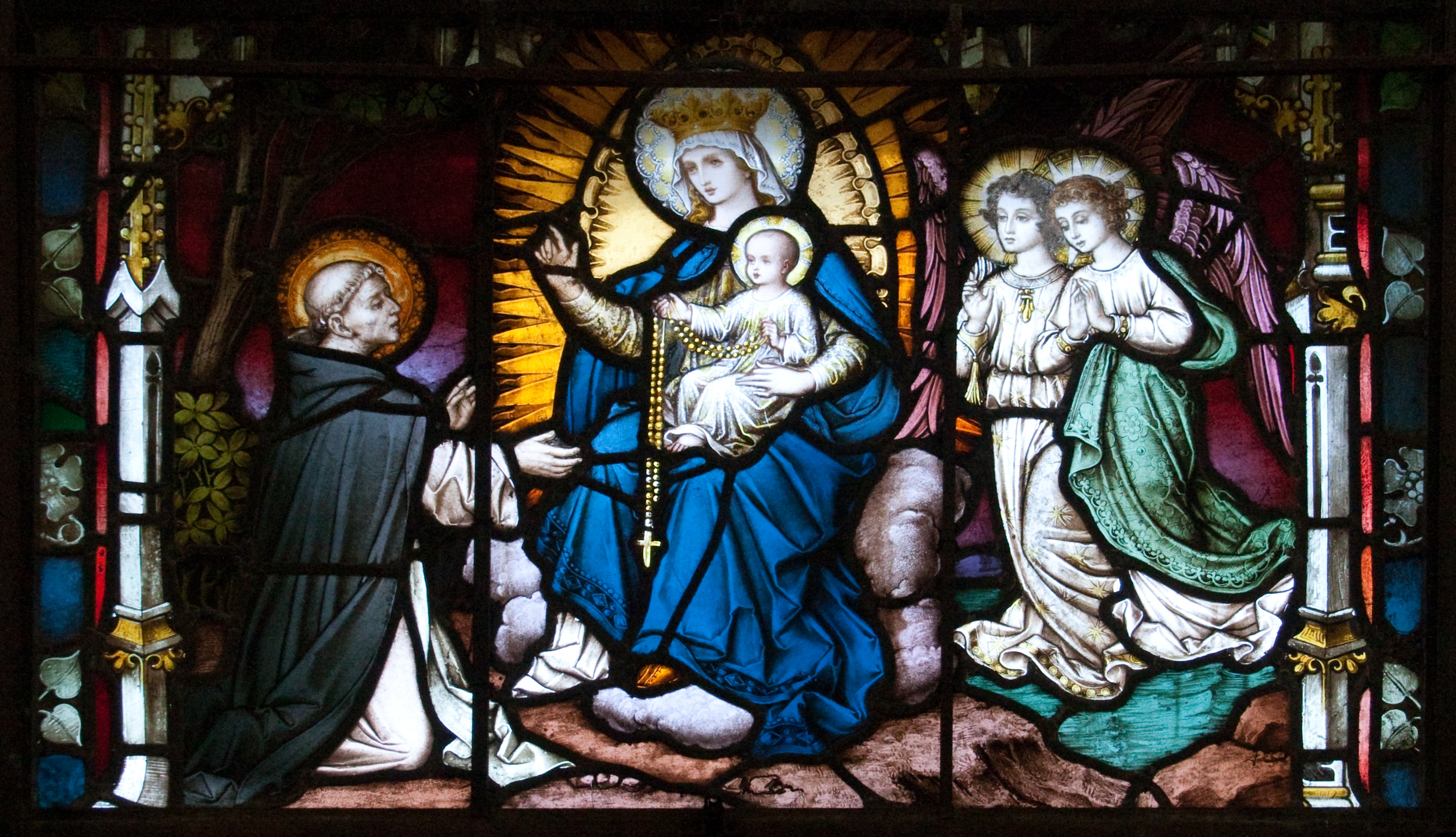
Our Lady giving the rosary to St. Dominic

I will hyperlink entries as they go up. They might not go up in order, since I'm still fleshing out the parallels on some of them.

The Joyful Mysteries
The Visitation
The Nativity
The Presentation in the Temple
The Finding of the Child Jesus in the Temple

The Luminous Mysteries
The Baptism in the Jordan
The Wedding Feast at Cana
The Proclamation of the Kingdom
The Transfiguration
The Institution of the Eucharist

The Glorious Mysteries
The Resurrection
The Ascension
Pentecost
The Assumption
The Coronation

The Sorrowful Mysteries
The Agony in the Garden
The Scourging at the Pillar
The Crowning with Thorns
The Carrying of the Cross
The Crucifixion